

Bicycle lights explained: lumen, lux and candela
10 April 2025
The terms Lumen, Lux, and candela. They all have something to do with your light's power, brightness, and strength. Although, it is very important to know the difference and have a little bit of a deeper understanding to make the right decision when buying a light. This blog can become a bit technical, but we will do our best to lead you through it step by step.
Lumen
Let's start with the simple one; Lumen. Lumen is a unit that expresses the amount of light that leaves the source. It tells you the intensity of the light source without giving you any information about the direction of that light. So, Lumen is the total amount of light that is emitted from a light source.
Lumen is a photometric unit. This means that it takes the human eye into account to determine its value. The intensity of the light source depends on how we perceive that light. For example; the human eye sees blue light as a more intense light than red. A blue light source with the same amount of watts will therefore have a higher amount of lumen than a red light with the same amount of watts, only because we perceive this light as more powerful.
We measure all our lights in Lumen, which you will find in the specifications of our lights. We do this because this is the amount of light emitted and thus important to determine the strength of a light source. It gives you the most fundamental value of the strength of your light, not impacted by a lens, direction, or anything else.

Candela
Candela is a bit more tricky. Where Lumen gives you the strength of all the light that is emitted from a light source, candela gives you a value of the light that can actually be seen, outside of the light source. In other words; light can be reflected within the housing of a light and become useless. Candela gives you the intensity of the light in a certain direction. In the case of our lights, the direction that is important is obviously the direction in front of you.
We don't give you this value in the specifications as it is only important in a very technical way of designing the lights. What is much more critical is Lux, which we will discuss in the next heading!
Lux
Now that you have an understanding of both Lumen and Candela, this last term will make complete sense and you will see why Lux is probably the most important unit we discuss here. Lux is the illuminance of a surface perpendicular to the light source. In other words; how much of the original light that is emitted (Lumen) will actually reach a particular surface in front of the light. Lux is given in lumen per square meter of the surface that is lit. You can imagine that this depends on how far the surface is from the light source.
For example: if the surface is only 50 centimeters away from the light source. You will see a massive bright light beam on the surface. If the surface is ten meters away from the light source, the light appears less strong on the surface but probably on a much bigger area. Lux completely depends on the distance at which it is measured. You will see in the specifications of our lights that the amount of Lux is given mostly on a one-meter distance. Below, you will find a simplified calculation of how Lux exactly works:
Let's say: a light has a total output of 500 Lumen. This 500 lumen shines on a surface one-meter from the light source. The illuminated area on the surface is exactly 2 square meters. That means that the amount of Lux (Lumen/m2) is 500 / 2 = 250 lux at a distance of 1 meter from the light source.

Lumen and Lux in real life
Now that we have explained the theory of the terms Lumen, candela, and Lux. We will help you understand these terms. Before reading this blog you would probably have thought that a 500 Lumen light is a better light in all dimensions. But it can have the same Lux at the 10-meter distance point output as another light. The difference between two lights is mainly the angle at which the light is spread out. The 'density of both lights is the same, the 500 Lumen are just spread out over a larger area, as for example an 300 Lumen light. Which gives you a good view of the area around you on the bike.
If a 500 Lumen light would have directed all its light on the same surface area as a 300 Lumen (and thus resulted in a higher Lux at a 10-meter distance) the human eye would have adapted to this extremely bright spot. The pupil will become smaller, which causes everything outside of the light beam to become even darker. In this case, it is more beneficial to keep the amount of Lux the same and increase the angle of the light for a better view.
Designing headlights requires finding the balance between all these variables. Different goals ask for different intensities and the spreading of the light. We have a wide range of different headlights, all with their own specific features. That way there will be a light available for everybody!
So, even though Lumen is an important value to determine the quality of a light. It does not say everything about what is actually done with that light and how it is used to make you be able to see the world around you in the dark. The combination of Lumen and Lux shows you exactly how the light is used and where it is directed to. Knowing both values makes you able to choose the right light for what you prefer.
Modes
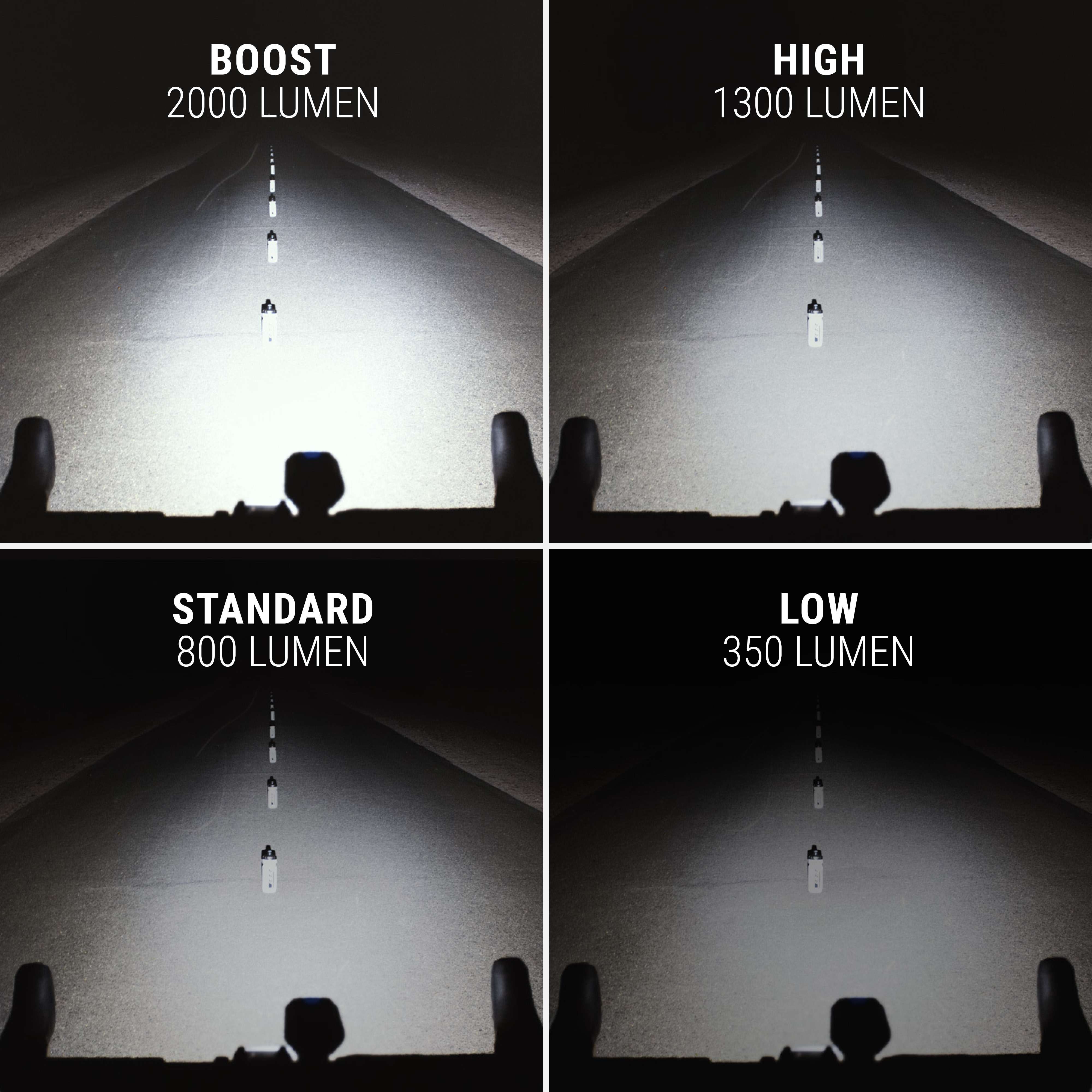
A lamp is more than just its strongest light output in Lumen. A bicycle light has several modes that give you the freedom to choose between extra-long battery life or extra power and intensity of light. Most of our lights have a low, standard, or city mode for use in traffic and a high or boost mode for those situations where extra light is needed. Our latest bicycle lights also have a daytime flash mode for daytime use. This provides extra daytime visibility when riding on roads shared with other traffic.
Every mode on our lights is designed to give you enough light in every situation.
Process all that information
We hope that you haven't lost interest in the magical world of lights yet. This quite technical blog may be a bit difficult, but it gives you a massive insight into how lights work. The information you have just gained can be very valuable when choosing your next bike light. You will be able to make a very considerate decision and you will be thankful for your well-chosen light every day!